Every supermarket champagne carries a small code on its label naming the firm that really made the wine. Behind Tesco Finest, Aldi's Veuve Monsigny or a Waitrose brut stands a co-operative or a champagne house from the Champagne region, bound by the same traditional method as Veuve Clicquot or Charles Heidsieck. Read the code, pick a named style such as blanc de blancs or blanc de noirs, and own-label champagne can match a premium champagne in the glass.
Is supermarket champagne real champagne?
Yes. If the word Champagne appears on the label, the wine was grown, pressed, fermented and bottled inside the protected Champagne region in France, whatever shop sells it. The same appellation rules apply to a store brand and to a prestige cuvee: only the permitted grape varieties (mainly Chardonnay, Pinot Noir and Pinot Meunier), the traditional method with a secondary fermentation in the bottle, and a minimum time on the lees. A non-vintage wine must rest at least 15 months after bottling, twelve of them on its yeast; a vintage champagne needs at least three years.
What changes is not the process but the choices made inside it: how long the wine sits in the cellar beyond the legal minimum, how much reserve wine goes into the blend, which villages the grapes come from, and how much sugar is added at the end. Those choices explain most of the gap in taste between one bottle of brut and another, and they are exactly where an own-label wine can be generous or stingy. Many people assume a supermarket bottle is a lesser product by definition; in our view that belief is the reason good own-label champagne is so often underrated.
Who really makes own-label champagne?
Supermarkets do not own vineyards in Champagne. They buy finished wine, or commission a blend, from producers who already sell under their own names. Three kinds of supplier dominate:
- Large co-operatives, which group thousands of growers and have the volume a national chain needs. Several of the biggest champagne producers by tonnage are co-operatives that also run their own brands.
- Negociant houses, the traditional champagne house model, which buy grapes and blend them. Some well-known houses quietly produce buyer's own brands to use surplus capacity.
- Family estates of medium size, which occasionally supply a premium own-label range such as a premier cru or a blanc de blancs.
The supplier behind a label can change from one contract to the next, so a bottle bought this Christmas may not come from the same cellar as the one bought two years ago. Reports in the wine press have linked Aldi's Veuve Monsigny to the family house Philizot, and Tesco Finest champagne to large co-operative groups, but the only reliable proof is the code printed on the bottle you actually hold.
How to trace the producer from the label
Every champagne 75cl bottle shows, in small type, two letters followed by a registration number. The letters describe the commercial status of the firm; the number identifies it with the Comite Champagne. Our guide to the codes printed on a champagne label covers each one, but for own-label wines three matter most.
| Code | Meaning | What it tells you on a supermarket bottle |
|---|---|---|
| MA | Marque auxiliaire, a brand owned by the buyer | The classic own-label case; the number points to the real maker |
| CM | Cooperative de manipulation | Made and bottled by a co-operative of growers |
| NM | Negociant manipulant | A champagne house that buys grapes; common on exclusive brands |
| RM | Recoltant manipulant | A grower using only their own fruit, rare in a supermarket |
Typing the registration number into a search engine, or looking at the town printed next to it, is often enough to name the cellar. When the town is Reims, Epernay or Ay, you are usually dealing with an established house; a small village name points to a co-operative or a grower. The alcohol content, around 12 to 12.5 per cent for most brut wines, tells you nothing about the maker, so ignore it for this purpose.
Questions shoppers ask before buying
What is the best supermarket champagne?
There is no single winner, because ranges change every year and competitions judge different vintages of the same label. The safest pick is an own-label bottle that shows a clear style (a blanc de blancs, a premier cru, a blanc de noirs brut) rather than a generic brut, since a named style forces the maker to meet a definition.
Is supermarket champagne worse than a big name?
Not by rule. A big brand pays for marketing, sponsorship and distribution; an own-label wine pays for none of it. The difference in the glass comes from ageing time and reserve wine, which you can partly check on the back label and in tasting reviews.
Where should you buy champagne in supermarkets?
Look at the premium own-label tier (Tesco Finest, Sainsbury's Taste the Difference, Waitrose, Asda Extra Special, Aldi Specially Selected) rather than the entry bottle, and time your purchase: the strongest champagne deals across the United Kingdom tend to appear before Christmas, then again around Valentine's Day and in January clearances.
When an own-label bottle beats a famous brut
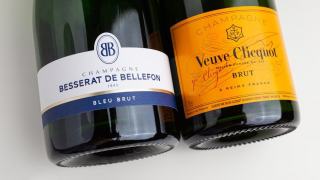
A comparison with a Moet Chandon brut, a Veuve Clicquot yellow label, a Taittinger, a Lanson, a Piper Heidsieck or a Nicolas Feuillatte is not always flattering to the big name, and the classic choice for a celebration is not automatically the best one. In blind tastings published by wine magazines, own-label wines regularly score close to, and sometimes above, the entry cuvees of the grandes marques. Four situations make that more likely:
- A style label. An own-label blanc de blancs or premier cru often uses better sourced fruit than the house's standard brut, which is blended for volume.
- Extra age. When the back label mentions three or four years on the lees, expect brioche and toasted aromas on the nose that many entry wines lack.
- A food setting. Served with a meal, a fuller own-label blanc de noirs made mostly from Pinot Noir, with ripe fruit and a rounder flavour, holds up better than a lean aperitif style; see our notes on pairing champagne with food.
- A gift for yourself. A big name makes sense as a gift where the label matters; for your own table, the maker matters more than the brand.
Where the grande marque still wins is consistency. A house such as Charles Heidsieck or Moet builds its non-vintage from a large bank of reserve wines, so this year's bottle tastes like last year's. An own-label cuvee can be excellent one season and dull the next, because the supplier or the blend may have changed.
What to expect in the glass
A good own-label brut shows fresh citrus, lemon and green apple on the nose, a subtle hint of pastry, fine bubbles, juicy acidity on the palate and a clean finish. The dosage of a brut is below 12 grams of sugar per litre; an extra brut or brut nature will taste drier and sharper. Signs of a weaker wine are a short finish, coarse fizz that fades within minutes, and a sweet, flat flavour that hides the fruit. A medal or award sticker helps less than you might think: it refers to one blend in one year, not to the label for ever. For the basics of the style, our guide to brut champagne and its sweetness levels explains what the word on the label promises.
Rose is where own-label ranges are most uneven. A brut rose made by blending in a little red wine is common and can be charming, with red fruit notes; a saignee rose is rarer on a supermarket shelf. If you like a pink glass of bubbly, taste one bottle before buying a case.
Buying and serving it well
Treat a supermarket bottle exactly as you would a famous one. Store it lying down, away from light (shelf lighting in stores is one reason to buy from the back of the display), and drink a non-vintage wine within a year or two of purchase. Chill it to 8 to 10 degrees, pour it into a tulip glass rather than a flute so the aromas can open, and keep an eye on the cork. Guides and supermarket wine apps can show you which product is stocked near you, but the tasting experience depends far more on temperature and glass than on the name. If a bottle smells of damp cardboard, it may be corked rather than simply modest, and any good store will take it back.
In short: read the code, favour a named style, check the age on the lees and taste before you stock up. Own-label sparkling wine from Champagne is not a gamble when you know who made it, and the savings can go into a second bottle.